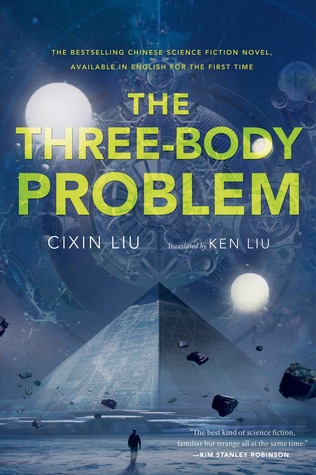
The Three-Body Problem (Remembrance of Earth’s Past, #1)
by Liu Cixin (translated by Ken Liu)
Published: Nov 2014 (first published 2007)
THIS is the hard sci fi I've been craving: chock full of physics thought-experiments, tedious descriptions of nanoparticle research and multi-dimensional folding, with a hefty dose of cult environmentalism. Plus it's written and set in China -- starting with the Cultural Revolution and spanning the decades leading up to present day-- so there's also heavy focus on the persecution of scientists and intellectuals by the Communist Party. So if you enjoy your dystopian fiction a little too real, look no further.
As a literary work it's not entirely consistent - there are some gloriously crafted passages with a fair share of dry, struggle-to-get-through moments. But I'm leaving the 5 star rating on Goodreads for the incredible ingenuity packed into the story. There's a lot to unpack here and I felt it all pulled together quite nicely.
Though for anyone interested in checking it out, a warning: definitely did myself a disservice listening to this over audiobook. On top of it being a bit more difficult to distinguish between names, there were so many times I wanted to go back and reread an especially technical passage or process described in a previous chapter with absolutely no idea how to scroll back and find it. Will definitely be adding this to my library as a hardcopy.
Showing posts with label astronomy. Show all posts
Thursday, January 4, 2018
Thursday, August 10, 2017
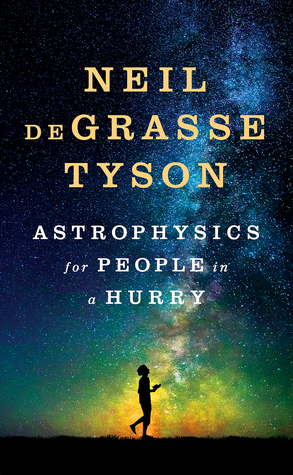
Astrophysics for People in a Hurry
by Neil deGrasse Tyson
Published: May 2017
A very compact, yet quite thorough sampling of astronomical topics. We bounce from the ingredients of the cosmos to particle physics, from relativity to dark matter and a quick breakdown of the electromagnetic spectrum. Woven into the science lessons, we also get some pushes toward critical thinking and humility:
"Ignorance is the natural state of mind for a research scientist. People who believe they are ignorant of nothing have neither looked for, nor stumbled upon the boundary between what is known and unknown in the universe."
Overall, well written and accessible, a must-read for anyone in need of a quick refresher course on the fabric of the universe.
4 out of 5 stars: As someone who loves to read pop-sci physics books but never made it past PHYS 101 in college (*ahem*), I knew this would be right up my alley. Then again, as someone who loves to read pop-sci physics books, I should have realized that there wasn't going to be lot of new information presented here. But that wasn't deGrasse Tyson's fault! This offers a good, solid base of information for anyone who wants to learn about astrophysics but gets overwhelmed by the trail of links you must follow when researching on Wikipedia.
Bonus: after listening to the audiobook, if you crave more NdGT, he gave the 100th commencement at Rice University which I was actually quite a bit bummed about missing (until I remembered how godawfulhot it is outside during graduation season)
by Neil deGrasse Tyson
Published: May 2017
A very compact, yet quite thorough sampling of astronomical topics. We bounce from the ingredients of the cosmos to particle physics, from relativity to dark matter and a quick breakdown of the electromagnetic spectrum. Woven into the science lessons, we also get some pushes toward critical thinking and humility:
"Ignorance is the natural state of mind for a research scientist. People who believe they are ignorant of nothing have neither looked for, nor stumbled upon the boundary between what is known and unknown in the universe."
Overall, well written and accessible, a must-read for anyone in need of a quick refresher course on the fabric of the universe.
4 out of 5 stars: As someone who loves to read pop-sci physics books but never made it past PHYS 101 in college (*ahem*), I knew this would be right up my alley. Then again, as someone who loves to read pop-sci physics books, I should have realized that there wasn't going to be lot of new information presented here. But that wasn't deGrasse Tyson's fault! This offers a good, solid base of information for anyone who wants to learn about astrophysics but gets overwhelmed by the trail of links you must follow when researching on Wikipedia.
Bonus: after listening to the audiobook, if you crave more NdGT, he gave the 100th commencement at Rice University which I was actually quite a bit bummed about missing (until I remembered how godawfulhot it is outside during graduation season)
Labels:
astronomy,
book review,
nonfiction,
reading is fun,
relevant xkcd,
science
Friday, August 4, 2017
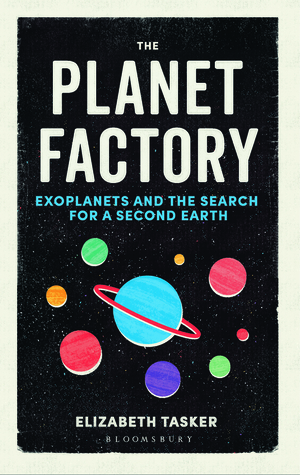
Planet Factory
Planet Factory: Exoplanets and the Search for a Second Earth
by Elizabeth Tasker
To be published: November 2017
In a fantastic primer for budding planetary scientists or armchair explorers, astrophysicist Elizabeth Tasker shares her passion and expertise for the astronomical sciences. Planet Factory chips away at the mountains of exoplanet research and presents it in approachable chunks of historical context, current research and exciting conjecture. Tasker describes how celestial bodies emerge from swirling space dust, details prevailing theories for the varying compositions of known planets and explores the incomprehensibly strange worlds that exist in distant systems (hot Jupiters, super Earths and rogue planets, oh my!).
4 out of 5 stars: There were some stretches of text in the middle that felt a bit tedious and recursive, going through the litany of possible explanations for any findings that didn't fit neatly into the currently accepted theories. But hey, that's science! The repetitive circular critique of hypotheses is both a strength and weakness in the text: it was honestly very refreshing to have each theory delineated with a little dollop of doubt, teaching the reader to question and critically assess previous explanations when presented with new evidence. It's even addressed point-blank in the introduction: any scientist trying to report this amount of interstellar research as fact with the pretense that 'we've got it all figured out' is doing a disservice to the reader and to the field. Overall, this is a very friendly introduction to the awe-inspiring mysteries of our universal neighbors.
Sidenote: I was a little surprised to see no mention of the TRAPPIST-1 system until I realized that announcement was just made February of this year, so of course the author didn't have time to cram in a whole new chapter of reactions to these 7 little buddies and their ultra-cool dwarf. That said, this book leaves me feeling well-equipped to tackle the news of exoplanet discoveries on my own.
// I received this book free from NetGalley in exchange for an honest review
by Elizabeth Tasker
To be published: November 2017
In a fantastic primer for budding planetary scientists or armchair explorers, astrophysicist Elizabeth Tasker shares her passion and expertise for the astronomical sciences. Planet Factory chips away at the mountains of exoplanet research and presents it in approachable chunks of historical context, current research and exciting conjecture. Tasker describes how celestial bodies emerge from swirling space dust, details prevailing theories for the varying compositions of known planets and explores the incomprehensibly strange worlds that exist in distant systems (hot Jupiters, super Earths and rogue planets, oh my!).
4 out of 5 stars: There were some stretches of text in the middle that felt a bit tedious and recursive, going through the litany of possible explanations for any findings that didn't fit neatly into the currently accepted theories. But hey, that's science! The repetitive circular critique of hypotheses is both a strength and weakness in the text: it was honestly very refreshing to have each theory delineated with a little dollop of doubt, teaching the reader to question and critically assess previous explanations when presented with new evidence. It's even addressed point-blank in the introduction: any scientist trying to report this amount of interstellar research as fact with the pretense that 'we've got it all figured out' is doing a disservice to the reader and to the field. Overall, this is a very friendly introduction to the awe-inspiring mysteries of our universal neighbors.
Sidenote: I was a little surprised to see no mention of the TRAPPIST-1 system until I realized that announcement was just made February of this year, so of course the author didn't have time to cram in a whole new chapter of reactions to these 7 little buddies and their ultra-cool dwarf. That said, this book leaves me feeling well-equipped to tackle the news of exoplanet discoveries on my own.
// I received this book free from NetGalley in exchange for an honest review
Labels:
ARC,
astronomy,
book review,
female writer,
netgalley,
nonfiction,
reading is fun,
science
Subscribe to:
Posts (Atom)